
Study & Productivity
How to Pass First and Second Semester Exams in Your First Year 100 Level

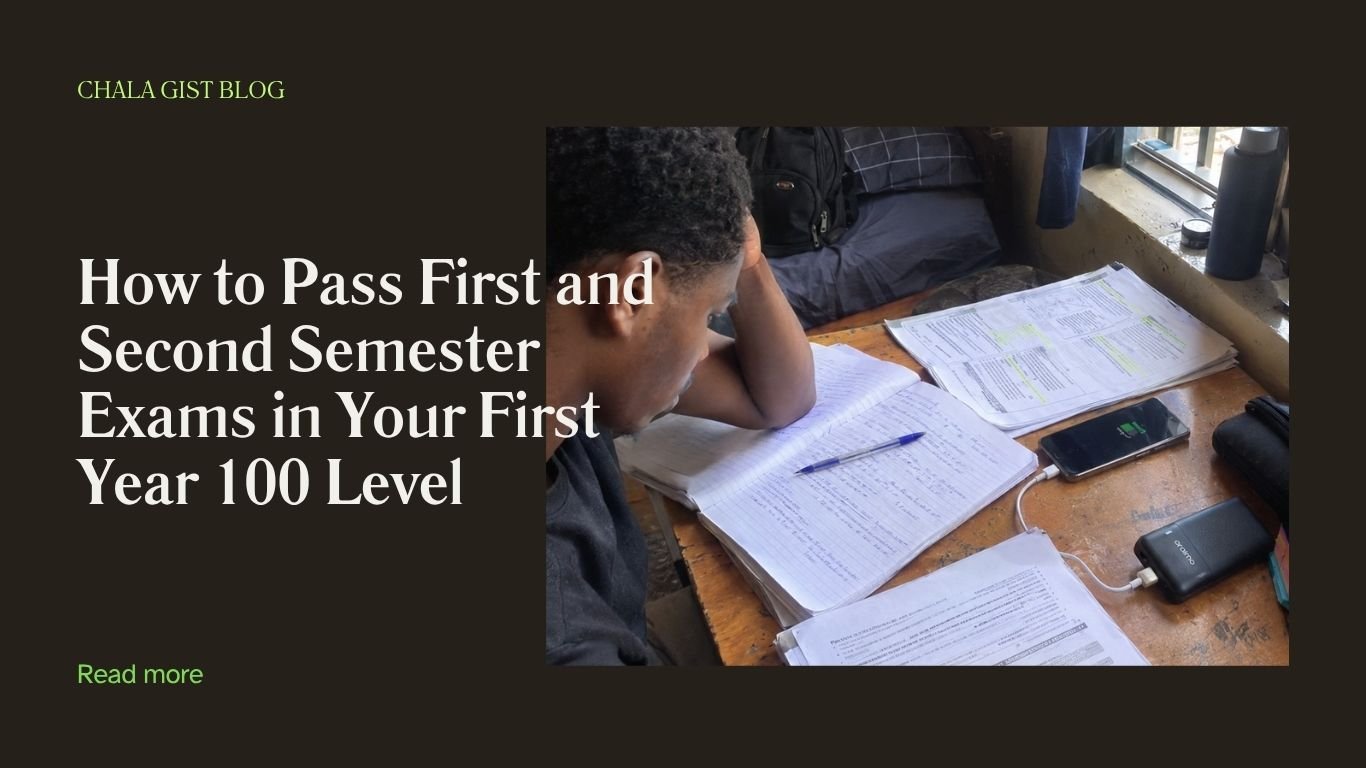
How to Pass Your First and Second Semester Exams in Your First Year: It is week eleven. Your bag is heavy with handouts you have not read. The exam timetable has just been pinned, and a coursemate casually says, “Which one are you starting with?” You smile like you have a plan.
You don’t. Not yet.
Good news: you can still build one, and it does not require being the smartest person in the class. This guide explains how to pass your first and second semester exams in your first year at a Nigerian university: what failing actually costs, which study methods have real evidence behind them, how to use past questions without relying on leaked papers, how to cope with NEPA, and what to do on exam day. It is written for freshers, and it works just as well if you are already a semester in and want to fix things.
Quick answer: Start in week one, review every lecture within a few days, test yourself from memory instead of rereading, spread your revision over weeks, use past questions after studying (not instead of studying), protect your sleep, and treat first semester results as feedback for second semester.
What “passing” really means in a Nigerian university
Before the tips, know the scoreboard.
Most Nigerian universities use a 5-point grading scale. According to a CGPA guide on Studentship.com.ng, a score of 70 to 100 earns an A (5 points), while 45 to 49 earns a D (2 points). An OpenEduCat explainer on Nigerian carryover rules describes an F as a score below 40 and says a failed course is a carryover: you must re-register for it and retake it in a later semester. It also notes that the minimum CGPA for a pass degree at most schools is 1.00 and that students whose CGPA falls too low can be placed on academic probation, which limits the credit load they can carry.
Exact rules differ by school and sometimes by department. So do two things this week:
- Read the grading and carryover section of your student handbook.
- Ask your course adviser what happens if your CGPA falls below the minimum.
Why this matters in first year: Your CGPA starts here. A carryover in 100 level is not the end, but it uses up time and energy later, when you are busier. Preventing it is cheaper than fixing it.
Why 100 level exams surprise people
Secondary school had teachers who chased you. University does not. Nobody will remind you to read, lectures move fast, and there is plenty of freedom. That freedom is nice until week eleven.
The students who struggle are often not “dull.” They simply start late, rely on methods that feel productive but aren’t, or let a few bad weeks snowball. All of that is fixable.
The study methods that actually work
Here is where most advice stays vague, so let’s be specific.
In a 2013 review published in Psychological Science in the Public Interest, psychologist John Dunlosky and colleagues compared ten popular study techniques. Two came out on top: practice testing (quizzing yourself) and distributed practice (spreading study over time rather than cramming). Five common habits, including rereading, highlighting and summarising, received low ratings. Dunlosky said he was surprised by how little benefit rereading and highlighting gave, and suggested replacing rereading with retrieval practice.
Translated into student life:
- Stop rereading the same handout five times. It feels like learning because the page looks familiar. That is not the same as remembering it.
- Close the handout and ask yourself questions. “What are the three causes of X?” Write the answer from memory, then check.
- Spread it out. Look at a topic within a few days of the lecture, again a week later and again before the exam. Short repeated visits beat one long marathon.
- Use feedback. Practice tests work best when you check the answers and fix mistakes.
That is not magic. It is just a more honest way to find out what you don’t know yet.
Your first-year semester map
Here is a timeline you can adapt. Semester lengths vary, so treat the week numbers as a rough guide.
Weeks 1 to 3: set up
- Register your courses properly and confirm your course codes and credit units.
- Get the course outline for every course. Note the lecturer, the topics and how marks are split between continuous assessment and the exam. Many schools include coursework or tests in your final score, though the split depends on your institution and department.
- Collect handouts, textbooks or recommended readings early. Chasing them in week 12 is stressful.
- Choose a reading spot and a routine. For help with that, see our guide to setting up a distraction-free study corner.
Weeks 4 to 9: build the habit
- Review every lecture within two or three days. Ten to fifteen minutes is enough to start: read your notes, write down questions about the why, not just the what.
- Do one weekly “quiz hour.” Pick one course per week and test yourself on everything taught so far.
- Do your assignments on time. They often feed into continuous assessment and show you how your lecturer thinks.
- Identify your hardest course now. Not in week 12.
Weeks 10 to 12: test and fix
- Do past questions under timed conditions (more on that below).
- Mark your own answers and list your weak topics.
- Spend more time on what you got wrong and less on what you already know.
Exam period
- Revise, practise and sleep. Do not try to learn an entire course for the first time.
Between semesters
- Calculate your GPA and see which courses dragged it down. Our CGPA walkthrough can help.
- Ask yourself what worked in the first semester and what didn’t, then adjust. Second semester is the same game with better information.
Make lectures count
You do not need to be a perfect note-taker. You need to avoid being lost.
- Attend, especially for courses you find hard. Hearing an explanation is different from reading a borrowed note. Coursemates’ notes are useful as backup, not as a replacement.
- Write down questions as they come. If something confuses you, mark it with a star. Ask the lecturer after class or during consultation hours, or ask a senior student.
- Ask “why” questions. Notes made of facts are hard to remember. Notes with reasons attached are easier.
- Connect new material to something you know. A concept you can link to everyday life sticks better than a random definition.
Use past questions the right way
Past questions are valuable. They show how a course is examined and which topics keep coming back. But there is a right way and a risky way.
The right way:
- Study the topic first.
- Attempt past questions with notes closed, within a time limit.
- Mark yourself honestly. Look up what you missed.
- Look for patterns, but don’t assume the same question will return.
The mistakes:
- Memorising answers. A lecturer can ask the same topic in a different way. If you only memorised the old answer, you are stuck.
- Starting with past questions. They are for testing, not for first-time learning.
- Chasing leaked papers or “expo.” This is not just unreliable. Nigeria’s Examination Malpractices Act treats cheating at examinations as a crime, with penalties that include fines and prison terms depending on the offence, according to the Act as published by PLAC. Your school can also discipline you. Use past questions from your department, course reps or seniors that came through normal channels, and focus on understanding.
Handle your difficult courses early
Not every course will feel equal. You may find one subject easy and another painful.
- Name the difficult courses in week two or three, not in the last week.
- Break them into small topics and give each a fixed slot in your weekly plan.
- Explain the topic aloud to someone, or to an imaginary class. If you can’t explain it simply, you don’t understand it yet.
- Ask for help early. A lecturer, a senior who did well in that course, or a coursemate who understands it can save you weeks.
Make study groups work (or skip them)
A good study group is two to five people who prepare in advance, quiz each other and stay on task. A bad one is a gist session with notes on the table.
If you join one:
- Set a day and time and keep it.
- Ask everyone to bring one topic they struggle with and one question to ask the others.
- Take turns explaining topics.
- Remove or leave the group if it keeps turning into phone-and-chat time.
Study groups can also help you make friends. We wrote a separate guide on that. Best Tips and Tricks to Make Good Friends in the University in Nigeria
Plan around NEPA, noise and data
Study advice that ignores Nigerian reality is not much use. So plan for it.
- Charge everything in advance. Phone, power bank, rechargeable lamp. A 20,000mAh power bank was listed at ₦7,899 in a 2026 Jumia anniversary-sale roundup by Naija Tech Guide, though sale prices change, so check Jumia Nigeria before you buy. See also our guide to dealing with NEPA outages.
- Have a Plan B reading spot. The library, a quiet classroom or a friend’s room with light.
- Study the hard stuff when your energy is high, whether that is early morning or after lectures. Save light tasks for noisy hours.
- Use data wisely. Download your materials once rather than streaming all day. See saving money on data and airtime.
- Put your phone away during study blocks. Notifications cost more attention than they seem to.
- Budget for materials. Photocopies, handouts and printing add up. Our semester allowance guide can help.
Sleep, food and breaks are part of the plan
The “reading from morning till night” approach feels heroic. It is not efficient.
A 2008 study by Pamela Thacher in Behavioral Sleep Medicine, summarised by Dr. Weil’s site, found that in one student sample, those who said they pulled all-nighters regularly had lower GPAs than students who got some sleep before exams. This is a correlation, not proof, but it fits what sleep researchers say about memory: Harvard Medical School’s sleep division notes that the period right after learning is critical for sleep and memory consolidation. A review of sleep statistics by StudyCards AI also points out that in one MIT study, sleep in the weeks before an exam related to scores more than the single night before. In other words, consistency matters more than one heroic sacrifice. (The popular claim that all-nighters cut memory by 40 percent traces back to an unpublished pilot study, so don’t repeat it.)
Practical rules:
- Aim for regular sleep during the whole semester, not just exam week.
- Study in blocks of 45 to 60 minutes with a 5 to 10 minute break.
- Eat properly. A body running on garri and stress is hard to focus.
- Drink water.
Health note: Don’t take unprescribed stimulants or “brain booster” pills to stay awake. They can have side effects and dependence risks, and they are not a substitute for preparation. If you want to use a supplement or medication, ask a pharmacist or doctor first. If exam anxiety is making it hard to sleep, eat or function, talk to your university’s counselling unit or health centre.
A recent trend: AI study tools (use them as a tutor, not a ghostwriter)
Student use of AI is no longer a side story in Nigeria. A Guardian Nigeria report dated 4 October 2026 notes that Nigerian students and lecturers are adopting AI tools such as ChatGPT quickly, and it describes a learning platform that found inaccurate AI-generated practice questions and added a review process before releasing them to students. A Nairametrics piece from June 2026 reports that the National Universities Commission has issued guidance on AI in higher education, but most campuses still lack enforceable rules, leaving students and lecturers to improvise. An earlier Nairametrics report quoted lecturers worried that students submit AI answers they cannot defend.
So how can you use AI without hurting yourself?
- Ask it to quiz you from your own notes. Paste a short section of your handout and ask for five questions, then answer them without looking.
- Ask it to explain a hard concept in simpler words, then check against your lecturer’s handout.
- Don’t trust it blindly. AI can produce wrong answers and invented facts. Verify anything that matters.
- Follow your department’s rules. Some lecturers ban AI for assignments. Never use any device in an exam hall unless it is clearly allowed.
- Don’t let it do your thinking. If AI writes your assignment and you can’t explain it, you have learned nothing for the exam.
Balance social life without losing your semester
Your first year is also for making friends and enjoying campus. That’s fine. The trouble starts when parties, relationships, scrolling and outings eat the hours you needed for lectures and revision.
A simple fix is to schedule fun the way you schedule study. Fix your study blocks first, then fill the rest. Tell friends, “I’m reading till 6, then I’m free.” Most people will respect it.
Exam week and exam day
Before the exam:
- Confirm the date, time and venue the day before. Don’t trust a rumour.
- Find out what you must bring (for example your ID or exam card, if your school requires one) and which items are allowed. Pack the night before.
- Do a short, light review of key points. Skip learning brand new topics.
- Sleep.
In the hall:
- Arrive early enough to settle.
- Read the instructions twice. Note how many questions to answer and from which sections.
- Plan your time by marks. Don’t spend half the exam on one question.
- If you get stuck, mark it and move on. Come back later.
- Do not carry unauthorised notes or devices. Copying, helping others cheat or carrying materials into the hall can bring both school discipline and criminal penalties under the Examination Malpractices Act.
After the exam:
- Don’t spend the evening dissecting every answer with coursemates. Reset and prepare for the next paper.
Safety and accuracy note: Grading scales, carryover rules and exam procedures differ across Nigerian universities. Treat the figures in this article as examples and confirm yours in your student handbook or with your department.
What I Actually Do the Night Before an Exam
Almost for three consecutive years now, anytime we are writing test or exam the next the day, the night before that exam day is usually very busy and occupied with me studying and revising everything that I have read before. Anyone material, note or textbook that I was not able to read before that night I won’t just border to touch it, I will just focus mainly on the topics and materials that I have read once or twice before for an intensive resvison.
A simple 12-week plan you can copy
| Weeks | Focus | Weekly time (adjust to your timetable) |
|---|---|---|
| 1 to 2 | Register courses, get outlines and handouts, set up reading spot | A few hours of organising |
| 3 to 5 | Review each lecture within 2 to 3 days; flag hard topics | 10 to 15 minutes per lecture plus one quiz hour |
| 6 to 8 | Weekly self-test on one course at a time; start study group if useful | 1 to 2 hours of testing plus normal review |
| 9 to 10 | Finish assignments; extra time on difficult courses | Increase study blocks gradually |
| 11 | Timed past questions, mark honestly, list weak topics | Daily practice under time limits |
| 12 and exams | Fix weak areas, light revision, sleep, exam logistics | Short focused sessions with breaks |
Frequently asked questions
When should I start reading for first semester exams?
In the first or second week. Review each lecture within a few days, then revise over several weeks. By exam time you should mostly be practising and revising.
Is reading past questions enough to pass?
No. They show style and common topics, but lecturers can change the question or topic. Study first, then use past questions to test yourself.
What study methods work best?
Practice testing and distributed practice came out top in the Dunlosky review. Quiz yourself from memory and spread revision across days and weeks. Rereading and highlighting rated low.
How many hours should a fresher study each day?
There is no universal number. Focus on consistent, focused blocks of 45 to 60 minutes with short breaks, spread across all your courses.
Is it okay to read all night before an exam?
Usually not. Sleep supports memory, and students who regularly pull all-nighters have been linked with lower GPAs, though that is a correlation. A short final review and a full night of sleep is safer.
What happens if I fail a course in 100 level?
It generally becomes a carryover that you must re-register and retake, and it affects your CGPA. Rules vary, so check your handbook and speak to your course adviser.
Can I use ChatGPT to prepare for exams?
Yes, as a helper for quizzing and explanations, but verify the answers and follow your department’s rules. Never use AI or any device in an exam hall unless it is clearly allowed.
Start with one week
You don’t have to fix the whole semester today. Choose one course, review your last lecture for fifteen minutes, close the handout and write down three things you remember. That small test tells you more than another hour of rereading.
Do it again next week with another course. Add a quiz hour, a study group that actually studies, and a full night of sleep before each paper. Your first semester will teach you how you learn. Use that in the second, and the habits you build now will make every later level easier.
If this helped, share it with a fresher who is panicking about exams, and tell us in the comments which study habit you are starting this week.


How to Stay Safe Walking Around Campus at Night
There’s a particular kind of tired that only hits you after a long night reading session, when you’re finally closing your books and the walk back to your room suddenly feels longer than it did in daylight.
I remember one particular night clearly. I’d been reading through the night at the Pharmacy Complex ahead of two exams scheduled back-to-back, and I was finally heading home after night class. A few minutes into the walk, along a stretch with no light close enough to matter, a group of guys walked up and demanded my phone. I tried explaining that I needed it for school, but they weren’t there for a conversation, and it turned physical before I let it go.
That’s really what this post is about — not scaring you off campus after dark, because for most of us that’s simply not realistic, but making sure the walk itself doesn’t have to be a gamble. A few consistent habits go a long way, and none of them require you to change your whole lifestyle.
Why Night Walking Is Just Part of Student Life Now

A View of Pharmacy Complex Building in UNN
If you’ve spent any time on a Nigerian university campus, you already know about TDB — “Till Day Break.” It’s the culture of reading through the night, usually in a faculty building, a reading room, or wherever has steady light and a bit of quiet, especially as exams close in. For a lot of students, TDB isn’t occasional; it’s practically a semester ritual.
The catch is that TDB culture means a lot more late-night and early-morning movement than people usually plan for. You go in at 10pm planning to read for “just two hours” and next thing it’s 4am and you’re walking back while the whole campus is dead quiet. Add night classes, project deadlines, and visiting a coursemate to finish an assignment, and you realize night walking isn’t really an exception in student life — it’s a fairly normal part of the routine that just doesn’t get talked about enough in terms of safety.
What makes TDB culture particularly tricky is the exhaustion factor. You’re not just walking at night — you’re walking at night while running on very little sleep, which is exactly when your alertness and decision-making are at their weakest. A lot of the small lapses that lead to uncomfortable situations (not noticing someone behind you, missing a turn onto a poorly lit shortcut, forgetting to charge your phone before heading out) happen not because students are careless, but because 3am-you is a much less alert version of the person who left the room at 10pm.
The Real (But Manageable) Security Picture

A Wider View of Pharmacy Complex Building in UNN
I’m not going to pretend campus security is a non-issue in Nigeria right now, because that wouldn’t be honest, and it wouldn’t be useful either. Several institutions around the country have had real security scares this year, and even UNN itself tightened things up earlier in 2026 — extra security personnel at entry points, some gates temporarily closed at night, and motorcycle movement paused inside the Nsukka campus at night — after a security rumor went round on social media. The university later confirmed there was no verified threat behind it, but the response itself tells you something useful: campus authorities take night safety seriously enough to act fast, even on an unconfirmed report.
That’s actually the right way to think about this. You don’t need to walk around campus jumpy or paranoid. You just need a small set of habits that you do automatically, the same way you automatically lock your door or charge your phone before bed. Most nights will be completely uneventful. The habits are there for the rare night that isn’t.
Before You Even Step Out

A view of Abuja building in UNN
A lot of night safety is decided before you leave your room, not during the walk itself.
- Charge your phone properly. A dead phone at 2am with nobody knowing where you are is a genuinely bad combination. Keep a power bank in your reading bag if your battery is unreliable.
- Tell someone your plan. A simple “I’m heading to the library, back by midnight” text to your roommate or a close coursemate costs nothing and means someone notices if you go quiet for too long.
- Know your route before you need it, not while you’re on it. Decide in advance which path you’re taking back, and prefer the one that stays closest to lit areas and other people, even if it’s slightly longer.
- Carry your ID card. Most campus security teams expect this, and it also just makes you easier to identify and vouch for if you’re ever questioned near a checkpoint.
- Dress for visibility if you can. Something as small as avoiding all-black on a genuinely dark route makes you easier to spot by security, okada riders, and other pedestrians.
Walking Habits That Actually Keep You Safer
Once you’re actually moving, a few habits matter far more than they get credit for.
- Stick to the well-lit, well-used paths, even if a shortcut through a quieter route saves you five minutes. UNN’s own security guidance has long advised students to avoid dark, isolated areas at night and to move with company where possible — that advice hasn’t expired.
- Walk with someone whenever you genuinely can. A group of two or three is a completely different equation from walking alone, and it costs you almost nothing to text a coursemate “I’m heading back now, you coming?”
- Keep at least one ear free, or skip headphones altogether on quieter stretches. Hearing footsteps behind you, a bike approaching, or someone calling out matters more than finishing your playlist.
- Stay off your phone screen while actually walking. Check messages before you set off or once you’re somewhere well-lit and populated, not with your head down mid-route.
- Trust a bad feeling over a “maybe I’m overreacting” thought. If a route, a person, or a situation feels off, change direction toward people and light. You’re allowed to be wrong about the danger and still make the safer call.
Common Night-Safety Mistakes Well-Meaning Students Make
Most students aren’t careless — they just don’t realize a small habit is working against them until something makes them notice. A few patterns worth watching for in yourself:
- Both earbuds in, volume up, on a quiet stretch. It feels normal because it’s how you’d walk in daylight too, but at night it removes one of your best early-warning systems: your hearing.
- Taking the “shorter” bush path because it saves five minutes. The math almost never works out in your favor — five saved minutes isn’t worth walking a route with no lighting, no foot traffic, and no easy way to call for help if something goes wrong.
- Flashing your phone screen at full brightness while walking. Beyond draining your battery faster, a bright screen in a dark area makes you easier to spot from a distance and harder for your own eyes to adjust to your surroundings.
- Assuming “I do this every night, nothing has ever happened” means nothing ever will. Familiarity is exactly what makes people relax the habits that were actually protecting them.
- Not knowing whether motorcycle or okada movement is restricted at night on your campus. Rules like this can change quickly — as UNN students saw when motorcycle operations inside the Nsukka campus were paused at night earlier this year — so it’s worth staying updated rather than assuming the usual arrangement still applies.
None of these mean you’re doing something wrong as a person. They’re just small adjustments that, once you notice them, are easy to fix.
Tech Habits Worth Building Into Your Routine
A few small tech habits have become genuinely common among students recently, and they’re worth adopting if you haven’t already.
- Share your live location with a roommate or close friend on WhatsApp when you’re heading back late — it takes ten seconds and means someone can actually see where you are if you go quiet.
- Save your campus security line and SUG welfare/safety contact in your phone, not buried in a group chat you’d have to scroll to find at 1am.
- Keep a flashlight app or your phone’s torch easily accessible — one tap, not three menus deep — for stretches where campus lighting is unreliable.
- Use a “arrived safely” text as a habit, not just when something feels risky. A quick “back in my room” message to whoever you told your plan to closes the loop properly.
What to Do If Something Feels Off

Computer science view of abuja building in UNN
If you ever sense something is wrong while walking at night, the priority is simple: get to people and light, not to prove or disprove what’s happening.
Move toward the nearest lit, populated area rather than continuing on an isolated stretch. Call a friend or your campus security line as you move, even if you’re not fully sure yet whether it’s serious — it costs you nothing to be cautious and everything to wait too long. Avoid confronting anyone directly; your job in that moment is to get safe, not to handle the situation single-handedly. And afterward, report what happened to campus security or your SUG welfare desk, even if nothing dramatic occurred — patterns matter, and reported near-misses are part of how security teams know where to focus.
My Honest Corner
That pharmacy complex night is really the reason this post reads the way it does.
I’d been reading straight through, running on almost no sleep, with two exams stacked back-to-back over the next two days. By the time night class ended, all I wanted was to get back to my room and grab whatever rest I could manage. A few minutes into that walk, on a stretch of road sitting in a dead zone between two lit areas, a group of guys came up and asked for my phone. I tried to talk my way out of it — told them it had things I genuinely needed for school — but they weren’t interested in a conversation. It got physical quickly, and by the time I finally let the phone go, I’d taken more than I want to relive in detail here.
I’m not sharing that for sympathy. I’m sharing it because it’s exactly the situation this whole article is built around: an unlit stretch, exhaustion from an all-night reading session, and being completely alone on a route with nobody close enough to help. I can’t honestly say I could have avoided it that night, but it’s a sharp reminder of why sticking to lit paths and walking with someone — even when you’re too tired to think straight — actually matters, and why I take those habits far more seriously now than I did before.
Building a Culture of Looking Out for Each Other
One of the more encouraging shifts I’ve noticed lately is how normal it’s become for students to build informal “walk back together” habits within their own circles — coursemates, lodge-mates, department classmates. Nobody needs to organize it officially; it usually starts with one person texting “who’s still around, let’s walk back together” in a class group chat, and it becomes a habit from there.
That kind of small, consistent looking-out-for-each-other does more for actual night safety than any single tip on this page. If you’re not already in a group chat that does this, it’s worth starting one yourself — you might be surprised how many people were quietly hoping somebody would.
Frequently Asked Questions
Is it actually dangerous to walk around Nigerian campuses at night? Most nights pass without any issue at all, but risk isn’t zero, especially on dark or isolated routes. The goal isn’t fear — it’s building habits that quietly lower your risk without changing how you live.
What is TDB and why does it matter for night safety? TDB (“Till Day Break”) is the popular culture of reading through the night, especially close to exams. It’s a big part of why so many students end up walking back to their hostel or lodge at odd hours, which is exactly why simple night-safety habits are worth having.
Should I use headphones while walking at night? Keep at least one ear free, or skip them entirely on quiet, isolated stretches. Hearing your surroundings matters more than finishing a song.
What should I do if I feel unsafe while walking? Move toward the nearest lit, populated area, call someone as you go, trust your instinct, and avoid confronting anyone directly. Report it afterward even if nothing serious happened.
Is it safe to walk alone at all? It’s always safer with company, but if you must walk alone, stick to well-lit, well-used routes, share your live location with someone, and let a friend know your plan before you set off.
Final Thoughts
Walking around campus at night isn’t something you can just avoid as a student — TDB alone guarantees that. But safety here isn’t about paranoia; it’s about a handful of habits you do automatically, the same way you lock your door without thinking about it. Know your route, tell someone your plan, stay in lit and populated areas, and build the kind of friend group that texts “let’s walk back together” without anyone having to ask twice.
For more on settling into campus and off-campus life without unnecessary stress, check out our guide to dealing with landlords off-campus and our guide to surviving NEPA outages.
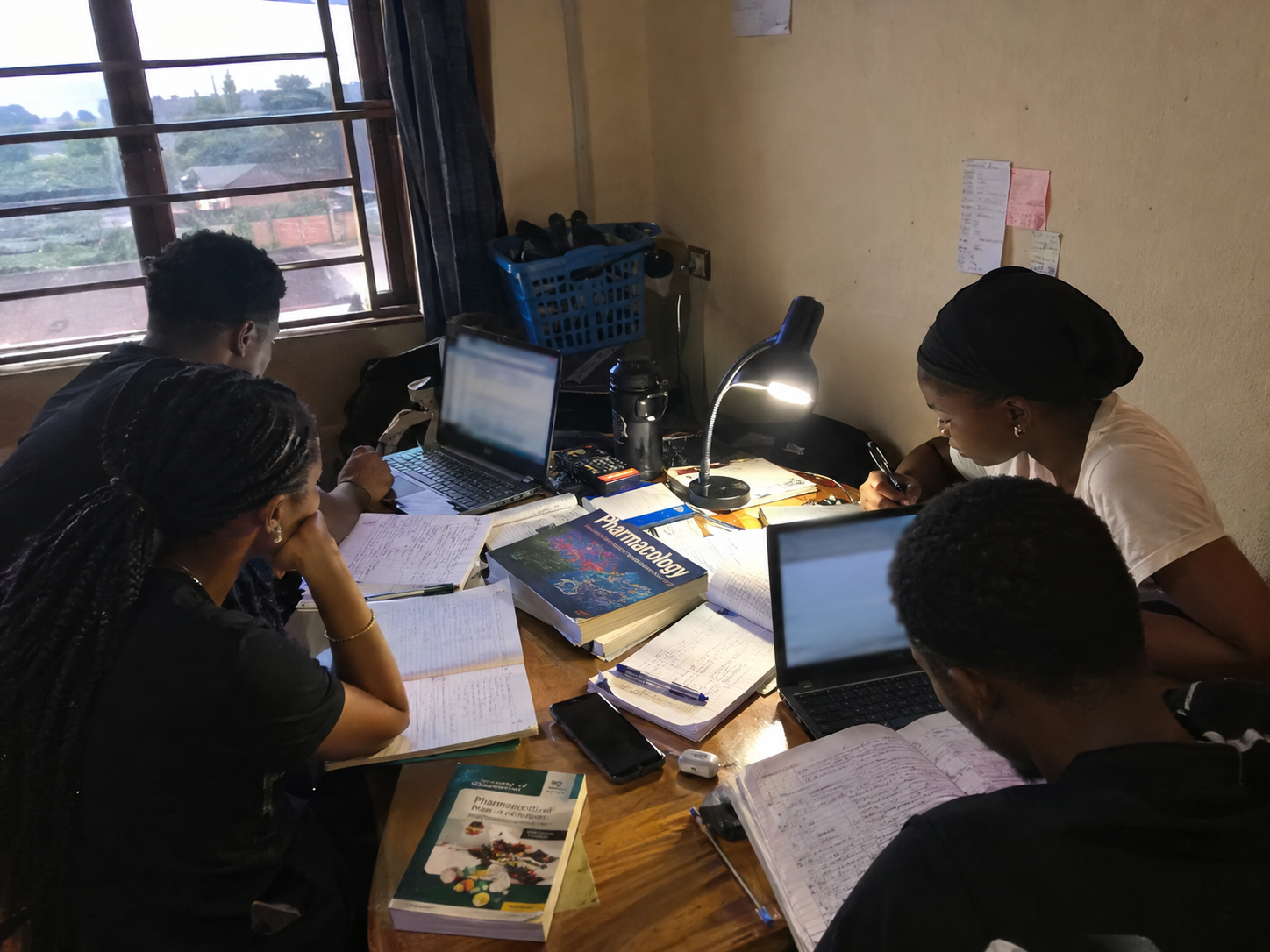
DIY Group Study Setup: How We Turned a Tiny Common Room and a Balcony into a Proper Study Space
Last semester, my study group almost died, and it had nothing to do with laziness. We simply had nowhere to sit.
There were four of us, all Pharmacy coursemates preparing for the same tough set of exams. The library was full by 8 a.m. My room could barely hold two people and a bucket. Every time we tried to study in the corridor, somebody’s speaker, somebody’s cooking or somebody’s long phone call swallowed the whole evening.
Then one Saturday, we looked at the small common room in our flat and at the balcony we only used for drying clothes, and one of us said, “Why are we not studying here?”
Three weekends and a small shared budget later, those two spaces became the place where most of our group studying happens. This post is the full story: the layout, the lighting, the balcony wahala, the rules, the money and the mistakes we made so that you can skip them.
If you live in a hostel, a self-contain or a shared flat and you want to study with friends without fighting for space, you can copy most of this in one weekend.
In this guide, you will learn:
- Why a group study setup matters more for Nigerian students right now
- The “body doubling” trend and why it works even without an app
- How to plan a small common room layout that seats four people
- How to fix light and power so NEPA does not end your session
- How to turn a balcony into a workable study zone (and how to keep it safe)
- A realistic naira budget, plus how to run a session that actually works
Why I Stopped Relying on the Library for Group Study
I want to be fair to the library. I still use it for silent, solo work, and nothing beats it for that. But a library is built for silence, and group study needs talking: explaining, arguing, correcting each other. That is exactly where the good learning happens, and exactly what the library does not allow.
There is also a bigger picture behind our small problem. According to a report in The Guardian Nigeria, fewer than 12,000 students can be accommodated on campus at UNN out of an estimated 45,000 enrolled. A June 2026 report by Fortren & Company, covered by PM News, put Nigeria’s student hostel shortage at more than one million beds, with under 9% of students having access to formal accommodation.
What does that mean in real life? More of us are squeezed into shared flats, off-campus rooms and crowded hostels, and the space we study in has to do more than one job. A common room is a TV room, a kitchen extension and a meeting point all at once. So if you want to study there, you have to design for it on purpose.
The Trend Behind This: Body Doubling and “Study With Me” Go Offline
While we were figuring this out, I kept seeing the same idea online. It is called body doubling.
The concept is simple. Body doubling means working on your own task while another person quietly works nearby, either in the same room or on a shared video call. You are not collaborating, but the presence of someone else focused makes it easier to stay focused yourself. The idea started in the ADHD community as a way to get past the “I cannot start” feeling, and it has since spread to students and remote workers in general.
It is properly mainstream now. Universities are running it as an event: the student affairs office at Texas Law, for example, is hosting structured body-doubling sessions with set study times, wellness breaks and snacks this very month. Online, apps such as Focusmate and StudyStream let you sit in a live room with strangers. One 2026 roundup says StudyStream alone has a community of over 270,000 students. And “Study With Me” videos, where someone simply studies on camera for an hour, have become a whole genre on YouTube.
Here is my honest take, though. Body doubling is not magic, and much of the evidence so far is informal or still developing, so I would not promise anyone it will fix their focus. But it matched what my group already felt: on days when we studied in the same room, even in silence, we got more done than on days each person struggled alone.
And here is the Nigerian twist. Online study rooms need data and steady power, and neither of those is guaranteed. The offline version costs nothing. You just need a decent place to sit together. That is really all our common room is: a body-doubling room with snacks. If you cannot be together in person, keep the online version as a backup (I will come back to that near the end).
Step 1: Decide What the Space Is For
Before we moved a single chair, we had a short conversation, and I now think it was the most important thing we did. We agreed that the space has two modes:
- Quiet mode: everyone works on their own material in silence. This is our body-doubling time.
- Talk mode: we explain topics to each other, quiz each other and argue about answers.
We gave each mode fixed hours. Talk mode was for the afternoon and early evening, when neighbours are also awake and moving around. Quiet mode took over later in the evening. Without this rule, the room drifts into a half-talking, half-studying mess where nobody gets proper focus and nobody gets proper discussion.
Write the two modes on a piece of paper and stick it on the wall. It sounds childish, and it works.
Step 2: Plan the Common Room Layout
Our common room is about three metres by three and a half. It had a small TV stand, a wobbly centre table and one long chair that everybody fought for. If your space is similar, these are the changes that made the biggest difference:
Push the table against a wall. A table in the middle of a small room eats all your walking space. Against the wall, it becomes a workbench, and people can sit on three sides.
Seat people in a horseshoe, not a circle. Everybody faces the table and the wall, so nobody stares at the TV or the door. Fewer distractions, easier to share a whiteboard.
Mix chairs and stools. Stools tuck under the table when you are not using them, which gives the room back to the flat when you are done. Four people is the comfortable number for a room this size. Five is the maximum before it turns into a party.
Keep one clear walkway. Somebody will need to pass to the kitchen or the toilet. If your layout blocks that, your flatmates will start hating your study group, and then the whole space is in danger.
Do the stand-up test. Once you have arranged everything, stand up and walk through the room as if you were going to the kitchen. If you have to squeeze past someone, adjust the layout again.
Sort your cables. We used one extension board and ran the cable along the wall with masking tape. Masking tape is your friend in a rented space because it does not damage paint. Put a piece of tape on each charger with the owner’s name so nothing goes missing at 11 p.m.
If your hostel room is the main place you study, you might also like my guide on building a DIY reading table and the post on creating a distraction-free study corner. The common room uses the same ideas, just at a group scale.
Step 3: Fix the Light and Power (Because NEPA Will Test You)
Anyone who has studied in Nigeria knows the feeling: you are halfway through a hard topic and the light goes. A group study setup that dies when NEPA takes light is not a real setup.
We solved it with three things.
1. A rechargeable desk lamp. When I checked Jumia Nigeria in September 2026, a rechargeable LED desk lamp with a phone holder and touch control was listed at ₦6,883 (down from ₦10,454), and a Taigexin rechargeable reading lamp was around ₦8,819. If you want something that doubles as an emergency light, a 3-in-1 lamp with a flashlight and hook was around ₦11,499. Prices move, so check the live listing before you buy.
One lamp is enough for a table of four if it has adjustable brightness, but two make a big difference to how much your eyes hurt after two hours. Place the lamp on the side opposite your writing hand so your hand does not throw a shadow on the page.
2. A simple charging routine. During light hours, we charge lamps, phones and power banks first, before anything else. We even agreed on a “charging corner” on the extension board so that nobody unplugs the lamp for a phone.
3. A no-screen fallback plan. When the light goes and the batteries are low, we switch to a teach-back round. That is when each person explains a topic out loud, using only a notebook and the lamp. It uses almost no power and, honestly, it is often our best round of the day.
If power cuts are your biggest headache, I wrote a full guide on studying through NEPA outages that goes deeper.
Step 4: Turn the Balcony into a Study Zone
The balcony was the part I doubted most. It was narrow, it faced the afternoon sun and it smelled faintly of detergent. But it turned out to be our favourite part of the whole setup, because it gave us something the common room could not: fresh air and a change of scenery.
Our balcony is only about a metre and a bit wide, so we treated it as a two-person “focus zone” rather than a full study room. Here is what we did.
Safety first. This is the part most blog posts skip, so let me say it plainly. Before you study on a balcony, check that the railing is solid and the floor is stable. Nobody should sit on or lean on the railing. Keep laptops and phones away from the edge. Do not crowd the space, and never treat it as an extra seat for a party. If the balcony feels shaky in any way, leave it alone and use the common room instead.
Table and seating. A foldable laptop table and two stools were enough. On Jumia, foldable laptop tables and stands were listing from roughly ₦3,900 to ₦4,400 when I looked. The advantage of foldable furniture is that you can pack it away in two minutes when it rains or when your landlord visits.
Shade. Afternoon sun on the balcony is brutal, and glare on a screen makes studying painful. A curtain or a simple cloth shade on the side facing the sun fixed most of it. Plan your balcony hours around the sun: for us, the early morning and the late afternoon worked best.
Rain and harmattan dust. In the rainy season, the balcony is a no-go for electronics unless it is properly covered. During harmattan, dust settles on everything, so we wipe the table before each session and keep laptops in a bag until we are ready.
Mosquitoes. Evening study on a balcony means mosquitoes. Use a repellent that is safe for you, and if you have a mosquito-proofing routine for your room, follow it here too. Our full guide on mosquito-proofing your hostel room covers the options.
Theft. Do not leave phones or laptops on a balcony table when you step away, especially if it is visible from outside.
What surprised me most is how different the balcony felt for silent work. Ten minutes outside, and my head was clearer than it had been after an hour in the crowded common room.
Step 5: Manage Noise and Neighbours

Photo credit: Premiumtimes
A study group that annoys the neighbours will be shut down eventually, so build the noise plan into your setup.
We do three simple things:
- Set talk-mode hours and tell flatmates and neighbours what they are. If people know when to expect discussion, they complain less.
- Use soft items. A mat or rug on the floor, a curtain on the window and even a few cushions absorb echo, and a small room echoes badly with four people talking.
- Keep the door and balcony conversation low. Sound carries in thin-walled buildings. If your walls are like mine, my post on soundproofing thin hostel walls has cheap fixes.
Respect goes a long way here. We once made egg sandwiches for the flatmate who had been patient with our noise. It cost almost nothing and bought us a lot of goodwill.
Step 6: Build a Shared Knowledge Wall
This was the cheapest upgrade with the biggest effect. We stuck a small whiteboard on the wall with masking tape, and next to it, a few sheets of paper for “topics covered” and “questions we could not answer.”
It gave the group a shared brain. Instead of every person keeping private notes, we could see what had been covered and what was still weak. When one of us got stuck on a topic, we wrote it on the wall and it became the next teach-back round.
If you cannot afford a whiteboard, use a large sheet of white cardboard or stick sheets of paper together. What matters is that the wall is visible from every seat.
What It Cost: A Realistic Naira Budget
Here is the rough budget for our setup. The lamp and laptop table figures come from Jumia listings I checked in September 2026. The rest are market-price estimates from my area, so treat them as a guide, not a promise.
| Item | Rough cost (₦) |
|---|---|
| Rechargeable desk lamp | 6,900 to 8,800 |
| Foldable laptop table or stand (balcony) | 3,900 to 4,400 |
| Extension board with surge protection | 5,000 to 8,000 |
| Two stools or plastic chairs | 6,000 to 10,000 |
| Whiteboard or marker board | 3,000 to 8,000 |
| Mat or rug | 3,000 to 6,000 |
| Masking tape, markers, paper | About 1,500 |
| Estimated total | About 29,000 to 47,000 |
Split four ways, that is roughly ₦7,000 to ₦12,000 each, less than one month of decent data for some people, and it lasts the whole semester and beyond. If money is tight, start with the lamp, the extension board and masking tape. You can add the rest week by week. For more ways to stretch your money, see my post on managing your semester allowance.
How We Actually Run a Session
A nice space is useless without a routine. This is the schedule we settled on after some trial and error:
- Goals (5 to 10 minutes). Each person says what they will finish in this session. Write it on the wall.
- Focus round 1 (25 minutes). Silent, phones in a basket. This is the body-doubling block.
- Short break (5 minutes). Stretch, water, a quick chat.
- Focus round 2 (25 minutes). Silent again.
- Teach-back round (30 minutes). One by one, each person explains a topic without looking at notes, and the others ask questions.
- Wrap-up (5 minutes). Write what is still unclear on the wall for next time.
The 25-and-5 rhythm is the classic Pomodoro method, and it is popular for a reason. The teach-back round is where the real learning gains come from. Research on retrieval practice, which means pulling information out of your memory instead of just re-reading it, shows that it tends to outperform more common approaches like repeated studying. Explaining a topic to friends forces exactly that kind of recall, and having them question you shows you the gaps quickly.
There is also some evidence that the two styles work well together. One summary of research on group work found that students who did more than one group session before practising alone could remember more material in the long run. In plain terms: use the group to sharpen your understanding, then test yourself alone afterwards. We now do a quick solo “brain dump” the next morning on whatever we discussed the night before.
Mistakes We Made (So You Do Not Have To)
<!– SWAP: replace with your real mistakes –>
- We bought a lamp that was too bright. It gave us headaches within an hour. Choose one with adjustable brightness.
- We ignored the afternoon sun. Our first balcony session was miserable because of glare. Now we plan around it.
- We had no fixed schedule at first. The common room slowly turned back into a TV room. A written timetable fixed that.
- We allowed food everywhere. Crumbs, oil and a spilled drink on a laptop keyboard taught us that food belongs at the break, away from the table.
- We let the group grow to seven. It felt friendly, but nobody could focus. We went back to four or five.
- We did not clean up after each session. Two days of mess and the flatmates were angry. Now the last ten minutes of every session is tidy-up time.
The Group Rules That Kept Us Together
Study groups often fail because of people, not space. These are the rules we agreed on, and we wrote them down:
- Phones go in a basket during focus rounds.
- Everyone arrives on time, and we start with or without you.
- Come with a goal, not just your body.
- No gossip during focus or teach-back rounds.
- Everyone teaches at least once per session.
- Tidy up before you leave.
- Anyone can call “time” if the group drifts.
It may feel too strict for friends. But these rules are what let us stay friends while actually passing our exams.
When You Cannot Meet: A Simple Hybrid Backup
Some days, a person is sick, stuck at home or travelling. For those days, we keep a video call open with cameras on and mics muted, so that person can still do their focus rounds with us. It is body doubling on a small scale. Just remember data and power: a short 50-minute session is enough, and it helps to charge everything beforehand. My post on free apps for Nigerian students lists tools that do not need much data.
Frequently Asked Questions
How many people can study in a small common room?
For a room of about three by three and a half metres, four people is comfortable and five is the maximum. Beyond that, noise and movement start to hurt everyone’s focus.
Is it safe to study on a balcony?
It can be, but only if the railing and floor are solid. Never sit or lean on the railing, keep electronics away from the edge and rain, and do not leave valuables unattended. If anything feels unstable, use another space.
How do I stop a study group from turning into gossip?
Use timed focus rounds, a phone basket, a written goal for each person and a fixed end time. Structure protects the group’s time, and nobody feels attacked because the rules apply to everyone.
What if NEPA takes light during the session?
Keep a rechargeable lamp and power banks charged, and switch to a teach-back round that needs little or no screen time. You lose almost nothing and the session continues.
Do I need permission to change a shared or rented common room?
If the space belongs to your landlord or is shared with flatmates, talk to them first. Use non-permanent fixes such as masking tape, freestanding boards and foldable furniture so nothing needs to be repaired later.
Final Thoughts
Studying in a group is one of the most useful habits I built as a student, but the habit only stuck when we gave it a proper place. That place did not need to be big or expensive. A small common room, a narrow balcony, one good lamp and a set of agreed rules were enough.
If you take only three things from this post, let them be these. First, split the space into quiet mode and talk mode. Second, solve light and power before you buy anything else. Third, keep the group small and the rules written down.
Start this weekend. Move the table, tape the cable to the wall, and invite two coursemates for one 25-minute round. You may be surprised how much a small space can hold.
If you try this setup, or you have a better idea for a small common room or balcony, drop a comment and tell me about it. I read every one. For more practical tips for hostel life, check out my complete guide to setting up your hostel room.
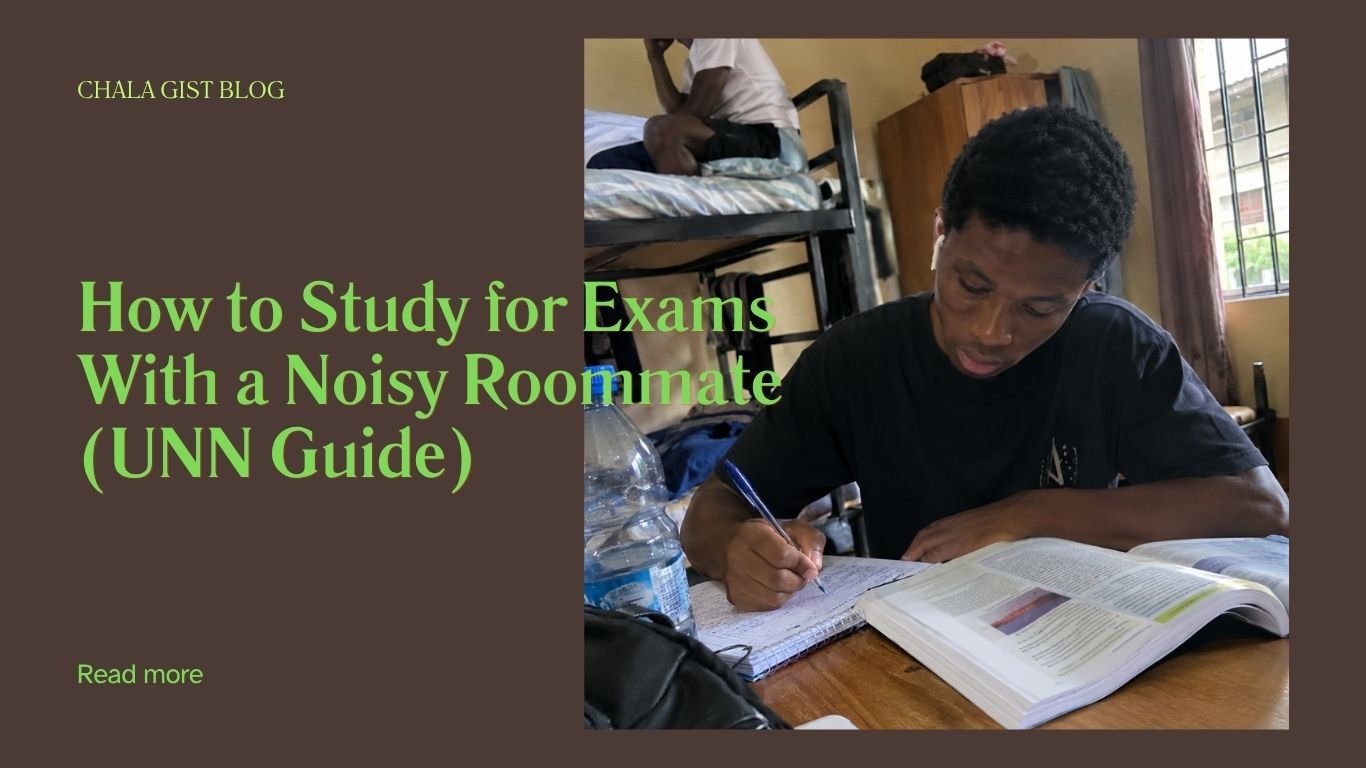
If you’ve ever tried to read Pharmacology at 9pm while your roommate is on a two-hour phone call, laughing like NEPA just brought light after three days, then you already know the kind of wahala I’m talking about. Exam period in a shared hostel room is a special kind of test — and I’m not talking about the one on your timetable.
I’m currently a 300-level Pharmacy student here at UNN, and I’ve spent enough semesters sharing a room to know that “noisy roommate” isn’t one single problem. It’s music at odd hours, it’s gist sessions that go on forever, it’s someone’s alarm going off seven times before they wake up, it’s a generator humming outside your window the same night you finally have light to study with. This post is everything I’ve actually tried, what worked, what wasted my time, and how I now prepare for exams without losing my mind or my roommate as a friend.
Why Hostel Noise Hits Different During Exams
Nigerian university student studying at a hostel desk with earbuds in while roommate talks in the background
Outside of exam period, noise is annoying but manageable. You can always “carry go” tomorrow. But once exams are close, your brain needs long, uninterrupted stretches to actually absorb information — not just read it. Pharmacology, Pharmaceutical Chemistry, Physiology — these courses don’t reward skimming. They reward the kind of deep, quiet focus that a six-in-a-room hostel space was never designed to give you.
The problem also isn’t only your roommate’s fault. Hostel rooms in Nigerian universities are built for sleeping and storage, not studying. Add thin walls, shared power sockets, generator noise from three doors down, and visitors who “just came to greet,” and you’ll understand why so many of us end up cramming in toilets, stairwells, and the back of lecture halls during exam week. If you haven’t sorted out your room setup yet, my Complete Guide to Setting Up Your Hostel Room and my post on soundproofing thin hostel walls are good places to start before exams meet you unprepared.
My Honest Corner Right Now
Let me be honest with you. Last semester, I had two roommates, and one of them loved his night calls. Not short calls — I’m talking calls that would start around 10pm and sometimes run past midnight, phone on loud speaker, laughing loud enough that I could hear the person on the other end too. It got so bad that during my Pharmacology CA week, I remember lying on my bed with my textbook open on my chest, stuck on the same paragraph for almost thirty minutes, because his laugh kept pulling my mind straight back into the room.
The night I still remember clearly was the Sunday before my Pharm Chem test. I had a full topic to cover, and by 11pm I had barely touched it. He was on a video call with his family back home, and every few minutes, someone on the other end would burst into laughter. I sat there vexed — not because he was doing anything wrong on purpose, but because exam period makes you sensitive to every small sound.
That night is actually what pushed me to sit him down the next morning and have the “quiet hours” conversation I talk about in Step 2. It wasn’t a fight. I simply told him straight, “Bro, this week is heavy for me, can we keep calls outside after 9pm?” He agreed almost immediately — he genuinely hadn’t realized how loud he’d been. That one conversation, plus a cheap pair of earbuds for the nights he forgot, changed my entire exam week. I won’t lie and say it’s perfect now, some nights still get loud, but I stopped treating it like a personal war and started treating it like a problem I could actually manage. Below is everything that has worked for me since then, and for coursemates I’ve compared notes with.
Step 1: Talk to Your Roommate Before Exams Reach
This sounds obvious, but most of us skip it. We’d rather manage the situation quietly and get vexed internally than have one honest conversation. The problem is, your roommate genuinely might not know their 11pm call or their music is disturbing you — especially if you’ve never said anything before.
The trick is to be specific, not general. “Please try to be quiet” doesn’t work because it doesn’t tell them what to actually change. Instead, try something like: “Bro, I have Pharm Chem CA this Thursday, can we keep things low after 9pm this week so I can read?” That’s a request with a reason and a deadline — much harder to ignore than a vague complaint, and it doesn’t sound like an attack.
Timing matters too. Have this conversation early in the semester or at least a week before exams start, not in the heat of a noisy night when you’re already annoyed. A calm ask lands very differently from an angry one, even if the words are almost the same.
Step 2: Set Unofficial “Quiet Hours” Between Yourselves
Most Nigerian university hostels don’t enforce official quiet hours the way some hostels abroad do, so if you want one, you and your roommate(s) have to create it yourselves. It doesn’t need to be a big house-rules conversation — it can be as simple as agreeing that from 9pm to 11pm, or 5am to 7am, phone calls happen outside and music goes on headphones.
If you have more than one roommate, a shared WhatsApp or room group chat actually helps here. Drop a message like “Exams start next week, can we try to keep 9-11pm calm for reading?” It gives everyone visibility and makes it a group agreement instead of you singling one person out, which reduces the chance of bad blood.
Step 3: Get the Right Gear (Even on a Student Budget)
You don’t need expensive gadgets to solve most of this. Here’s what actually makes a difference, from cheapest to most effective:
- Foam earplugs — the most underrated tool in this entire guide. They’re cheap, available at any pharmacy or supermarket, and block a surprising amount of low-level chatter and background noise. Perfect if your budget is tight this semester.
- Basic wired or budget wireless earbuds — even a simple pair paired with focus music or noise apps can mask a lot of disturbance. Budget wireless earbuds are widely available on Jumia in the lower price range, good enough for daily study use without breaking your semester allowance.
- Mid-range earbuds with some noise isolation — a step up if you can stretch your budget slightly, especially useful if your room is close to the generator house or a busy corridor.
- True ANC (Active Noise Cancelling) earbuds — these actively cancel out steady background noise like generator hum or fan noise, not just block it physically. They cost more, so treat this as a “if I can save toward it” option rather than a must-have. Prices for ANC earbuds change often, so it’s worth checking current listings on Jumia before you commit your money.
Whatever you choose, don’t wait until the week before exams to sort your gear out. Sound-blocking tools take a bit of getting used to, and you don’t want your first night with new earbuds to be the night before a CA. If you’re trying to figure out where this fits into your semester spending, my post on managing your semester allowance has more on budgeting for small but important purchases like this.
Step 4: Try Noise-Masking Sound (The Brown Noise Trend)
You’ve probably seen “brown noise” trending online — those long YouTube or Spotify tracks that sound like a deep rumble, almost like distant thunder or a steady waterfall. It’s become a big trend among students and even people with ADHD who use it for focus, and honestly, I understand the appeal in a hostel setting.
Brown noise doesn’t erase your roommate’s noise completely, but it “masks” sudden, sharp sounds — a laugh, a door bang, a phone ringtone — by giving your brain a steady, predictable background sound to lock onto instead. It’s worth being honest here: the scientific evidence that brown noise directly boosts focus is still limited, and some research hasn’t found a strong difference between brown noise and plain white noise. But plenty of students swear by the calming, masking effect, and it costs nothing to try. Search “brown noise study” on YouTube or Spotify, put in your earbuds, and see if it helps you personally — everyone’s brain reacts a little differently to it.
Step 5: Study “With” Someone — Even a Stranger Online
Here’s a trend that’s picked up serious momentum recently and honestly surprised me when I first tried it: “study with me” livestreams. This started years ago in South Korea as what’s called “gongbang” (study broadcast) and has since exploded globally, with students literally livestreaming themselves quietly studying for hours, while thousands of other students watch and study along with them — no talking, just the shared feeling of not being the only one grinding.
It sounds strange until you try it. There’s something about seeing another student’s desk, hearing pages turn, and knowing someone else is also fighting to focus that makes your own noisy hostel room feel a bit less like a battlefield. You can find hours-long “study with me” videos on YouTube, or join live study rooms on Discord where Nigerian students gather during exam season specifically for this. It won’t cancel your roommate’s noise, but it gives your brain a different, quieter “room” to mentally sit in.
Step 6: Change Location When the Noise Is Unbeatable
Some nights, no amount of earbuds or brown noise will save you — especially if there’s a full gist session happening two feet from your reading table. On those nights, the smartest move is to simply leave.
Your department’s reading room, the faculty library, an empty lecture hall, or even a quiet corner of the hostel common room during off-peak hours can save your exam prep on nights your room turns into a social event. Yes, it’s extra stress to pack up and relocate, but it’s far less stressful than staring at the same paragraph for forty minutes while a comedy skit plays in the background.
Step 7: Master the Quiet Window
In most hostel rooms, there’s a natural quiet window — usually very early morning before your roommate wakes up, or late at night after they’ve finally gone to sleep. These windows are gold during exam period.
If you’re naturally more alert in the morning, try sleeping earlier and waking by 4am or 5am to read while the hostel is still calm. If you’re more of a night owl, the hour or two after your roommate sleeps but before you get too tired yourself can be some of your most productive study time. The key is protecting that window on purpose — don’t let it slip away scrolling your phone, because it might be the quietest 90 minutes you get all day.
Step 8: Use Short Focus Blocks (Pomodoro) to Work Around Interruptions
When your environment is unpredictable, trying to force three straight hours of reading is setting yourself up to fail. Instead, break your study time into short, focused blocks — 25 minutes of reading, then a 5-minute break, repeated a few times. This is often called the Pomodoro technique, and it works especially well in a noisy hostel because even if you get interrupted, you’ve only “lost” a short block, not your whole evening. It also makes starting to read feel less overwhelming when you know a break is coming soon.
Dealing With NEPA, Generator Noise, and Roommate Noise Together
Let’s be honest — sometimes it’s not just your roommate. NEPA takes light, the whole floor’s generators come on at once, and now you’ve got engine hum layered under your roommate’s phone call. This combo is peak Nigerian hostel wahala, and it deserves its own approach.
On generator nights, earplugs alone might not be enough since the hum is constant and low. This is exactly where noise-masking sound (Step 4) earns its keep, because a steady brown noise or instrumental track can blend with a steady generator hum better than it can with sudden sharp noise. Pair that with earbuds that fit snugly, and consider positioning your reading table away from the window facing the generator house if your room layout allows it. My post on dealing with NEPA outages in your hostel room covers more on managing power situations generally.
When Nothing Works: How to Escalate Without Drama
If you’ve talked to your roommate calmly, tried gear, tried quiet hours, and the noise is still consistently wrecking your ability to prepare for exams, it’s fair to escalate — just do it the right way. Speak to your hall warden, porter, or student affairs office, calmly and with specifics (dates, what happened, what you’ve already tried). Most halls take repeated noise complaints seriously, especially during exam period, and room reassignment or a formal warning is sometimes the only thing that actually changes a habitually noisy roommate’s behavior. This should be a last resort, not your first move — but don’t be afraid to use it if your exams are genuinely at risk.
Frequently Asked Questions
How do I study with a noisy roommate without causing a fight? Talk to them early, calmly, and specifically — name the exact noise and the exact time you need quiet, instead of a vague complaint. Most roommate noise wahala comes from them not realizing it’s a problem, not from wickedness.
What is the cheapest way to block noise in a hostel room? Foam earplugs are the cheapest option and cost very little at any pharmacy or supermarket. Basic earbuds playing brown noise or instrumental music are the next affordable step before you consider ANC earbuds.
Does brown noise actually help you study? It mainly works by masking sudden sharp sounds like laughter or a slammed door, which is why it feels calming. The evidence that it directly boosts focus is still limited, but many students genuinely find the masking effect useful in a noisy hostel.
What can I do if my roommate refuses to keep quiet during exams? If a calm conversation doesn’t work, change your study location during their peak noise hours, protect a quiet window early morning or late night, and if it becomes a repeated pattern affecting your grades, report it to your hall warden or porter.
Final Thoughts
A noisy roommate doesn’t have to mean a ruined exam season. Most of what works isn’t expensive — it’s a mix of honest conversation, a bit of gear, knowing when to leave the room, and protecting the quiet windows you do get. I won’t lie and say every night will be silent, because hostel life in UNN will always come with its own wahala. But with a system in place, that wahala stops controlling your reading time.
If your room setup itself is part of the problem, start with my Complete Guide to Setting Up Your Hostel Room — it covers everything from a proper reading table to organizing your space for fewer distractions in the first place.
MORE TO CHECK OUT:
- How to Organize a Nigerian Hostel Room on a Small Budget
- DIY Reading Table for Under ₦10k: How I Built Mine in a Weekend
- How I Fixed My Leaking Tap in My Hostel Room Without Calling a Plumber
- How to Decorate a Small Hostel or Lodge Room Without Spending Much As a Student
- How to Make Your Room Smell Good and Stay Clean With Limited Space
- How to Deal With NEPA (Power) Outages as a Student
-
DIY Mosquito-Proofing Your Room: How I Stopped Fighting Mosquitoes Every Night in My Hostel
-
How to Soundproof a Thin Hostel Wall Cheaply (Without Wahala or Wasting Money)
-
How to Budget Your Semester Allowance as a Nigerian Student (To Avoid Borrowing From Loan Apps)
-
10 Cheap Foodstuff Combos That Actually Fill You Up on Campus (2026 Guide)
-
How to Cook Without a Kitchen: Hostel-Friendly Meals With One Burner


How to Pass First and Second Semester Exams in Your First Year 100 Level

Best Tips and Tricks to Make Good Friends in the University in Nigeria

Top 10 High Paying Side Hustles for Students in Nigeria in 2026

DIY Reading Table for Under ₦10k: How I Built Mine in a Weekend

Okrika Shopping Guide for Nigerian Students: How to Thrift Smart Without Wasting Your Allowance

10 Cheap Foodstuff Combos That Actually Fill You Up on Campus (2026 Guide)
-
Hostel & Self-Contain DIY4 weeks ago
DIY Group Study Setup for a Small Common Room or Balcony
-
 Hostel & Self-Contain DIY4 weeks ago
How to Do Laundry Without a Washing Machine (Fast Guide)
-

 Campus Survival Guide4 weeks ago
How to Stay Safe Walking Around Campus at Night
-
 Student Side Hustles & Income2 weeks ago
Top 10 High Paying Side Hustles for Students in Nigeria in 2026
-
 Student Side Hustles & Income4 weeks ago
How to Stay Motivated During ASUU Strike: 9 Practical Steps
-

 Campus Survival Guide4 weeks ago
Dealing With Landlords: A Student’s Off-Campus Guide
-
 Campus Survival Guide2 weeks ago
Best Tips and Tricks to Make Good Friends in the University in Nigeria