
 Chala Gist
I remember the exact night I gave up on “studying” in my room and just started scrolling Instagram instead. It was during Pharmaceutical Microbiology revision in my 300 level, and I had a test in two days. I sat at my little reading table by the window in my hostel room here at the University of Nigeria, Nsukka, and opened my note. I read exactly one paragraph before one of my roommates’ phone speaker started blasting Afrobeats from her side of the room. By the time I looked up again, forty minutes had passed and I hadn’t turned a single page.
If you’re reading this in your own hostel room right now, phone in one hand, textbook open and forgotten in front of you, I already know your situation. I’m in a room with three other girls — a fairly normal setup for most of us in a “normal session” here at UNN. On paper, our room is actually well arranged: everybody has their own corner, nobody is fighting for space, and it’s not the congested nightmare some hostels have become. But having your own corner and having a corner that actually helps you focus are two completely different things. My corner, right by the window, used to just be where my bed and box were. It took me a while to realise I had to deliberately turn it into a study zone, not just leave it as “my side of the room.”
This is the guide I wish someone had handed me in my first year at UNN. I’m going to walk you through exactly how I turned my corner by the window into a spot where my brain automatically switches into “read mode” the moment I sit down — even with three roommates around, even with NEPA doing wonders, and even on a student budget. I’ll also touch on something a lot of study guides ignore: the 2026 reality that our phones, not our roommates, are usually the real enemy.
Why the Corner You Study In Matters More Than You Think
Before I fixed my setup, I genuinely believed my problem was discipline. I thought I just needed to “try harder” to concentrate. Turns out, that’s only half true.
Research on study environments consistently shows that students who have one consistent, distraction-controlled spot for reading complete their work meaningfully faster than students who study wherever is convenient — on the bed, at the dining table, wherever their laptop happens to land. One frequently cited study of secondary and university students found that those with a dedicated study space finished assignments close to a quarter faster than those without one, not because they were more motivated, but because their brains weren’t wasting energy constantly re-adjusting to a new environment every time they sat down.
That’s the real secret behind a “distraction-free corner.” It’s not about having a fancy desk. It’s about training your brain to recognise: “this spot means we are reading now, not resting, not scrolling, not chatting.” Once that association is built, you stop fighting yourself every single time you want to read.
For those of us in shared rooms, this is harder to pull off — but it is absolutely possible. In my case, since everyone in my room already had their own corner, the challenge wasn’t finding space. It was turning my existing corner from “just where I sleep and keep my things” into a spot my brain specifically associates with focus.
The Real Reason Nigerian Students Struggle to Focus in Shared Rooms
Let’s be honest about what we’re actually dealing with, because most study tips online are written for someone with their own bedroom and a door that locks.
In many Nigerian tertiary institutions, hostel accommodation is in short supply, which means rooms built for two students often house three, four, or even more people. Even in a “well-spaced” room like mine, four people means four sets of habits, four different course loads, and four different ideas of what counts as reasonable noise at 9pm. Add the social side — calls, visitors, gist that starts at dinner and somehow continues till midnight — and the shared reality of NEPA taking light right when you need to charge your reading lamp or laptop, and you start to see why “just focus” is easier said than done.
None of this means a distraction-free corner is impossible. It means the setup has to be realistic for our actual environment, not copied from a YouTube video of someone’s private dorm room in another country with reliable electricity and no roommates at all. Everything below is built around that reality.
Step 1: Turn Your Existing Corner Into an Actual Study Zone
If your room is like mine, you probably already have “your side” of the room. That’s a good starting point, but it’s not automatically a study corner — it’s just where your bed and box happen to be.
Before rearranging anything, be honest with yourself about your current corner:
- Is your reading table doubling as a dumping ground for clothes, provisions, or random files?
- Can you see your bed from where you sit? (If yes, your brain is constantly being reminded that sleep is an option.)
- Is your corner close enough to a socket, or will you need an extension box?
- Does your spot get natural light, or will you be relying on the room’s bulb?
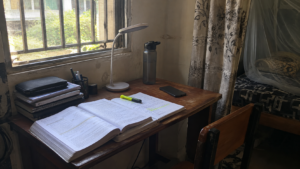
My corner is by the window, which turned out to be a genuine advantage — good natural light in the daytime, which meant fewer eye-strain headaches during long reading sessions, and I could always tell what time it was without checking my phone every five minutes.
Since we already each have our own space, I didn’t need to “claim” territory from my roommates. What I did instead was have an honest conversation with all three of them about protecting a specific time window, not a specific space. Something as simple as, “Between 8 and 10pm, I’m trying to actually read, please” goes a long way when everyone already respects each other’s corners.
Complete Guide to Setting Up Your Hostel Room — if you haven’t fully organised your side of the room yet, start there before fine-tuning your study corner, so you’re not fighting clutter from every direction.
Step 2: Build a Physical Boundary, Even a Small One
You don’t need a wall to create separation. You need a visual and psychological cue that says “this is a different zone,” especially since your study corner and your sleeping corner are often the same three square feet.
A few options that actually work in Nigerian hostel rooms:
- A curtain or fabric divider hung from a rod or nailed string between your desk area and your bed. A simple curtain length from a local fabric market here in Nsukka typically runs somewhere around ₦3,000–₦6,000 depending on the material and how much you need, and it made a bigger psychological difference than I expected — it’s a genuinely underrated hack.
- A tall shelf or box stack positioned to block direct eye contact with your own bed while you’re at your desk.
- A “reading time” sign — even a simple paper note taped above your desk that says “Studying till 10pm” tells your roommates not to disturb without you saying a word every time.
- Headphones as a social signal, not just for sound. In many shared rooms, seeing someone with headphones on (even without music playing) is now understood as “leave me for now.”
The goal isn’t privacy in the literal sense — it’s a boundary your brain and your roommates both recognise instantly.
Soundproofing Thin Hostel Walls — pair this section with that guide if noise from neighbouring rooms, not just your own roommates, is your bigger problem.
Step 3: Set Up the Physical Desk Area (On a Real Student Budget)
Your “desk” doesn’t need to be expensive furniture. It needs three things: a flat surface, decent lighting, and a way to keep only what you’re currently using within reach.
Surface: A foldable reading table, a wide plank across two boxes, or even a sturdy tray by your window corner works. If you’re building from scratch, our DIY reading table tutorial shows you how to make one for far less than buying.
Lighting: This is where most students get it wrong. Overhead hostel bulbs are usually too dim or too harsh for long reading sessions, and NEPA means you can’t always rely on wall power anyway. A decent rechargeable LED desk lamp currently goes for around ₦6,000–₦9,000 on Jumia (basic clip-on models sit at the lower end, ones with a phone holder or higher battery capacity sit closer to ₦9,000), and it solves both problems at once — proper light angled at your book, and it survives a blackout. Since I’m right by the window, I actually only need the lamp after dark, which has saved me a lot of charging stress.
Keep only what’s needed: Move everything except your current subject’s materials off the desk. Yesterday’s notes, unrelated textbooks, your provisions, all of it goes elsewhere. A cluttered desk creates what researchers call “visual noise” — your brain processes all of it even when you’re not consciously looking at it, which quietly drains your focus. If you’re constantly hunting for a free socket for your lamp, phone, and laptop at once, a simple extension socket (around ₦5,000–₦6,000 for a decent multi-socket one) parked permanently at your desk saves you the daily scramble.
Hostel Room Organization Tips for ideas on where to store everything you’re removing from your new desk.
Step 4: Deal With the Real Distraction — Your Phone
Here’s the part most “study space” articles skip, and it’s the part that matters most in 2026.
You can build the most beautifully arranged, distraction-free corner in the world, and it won’t matter if your phone is sitting face-up beside your book. Right now, there’s a growing, genuinely useful trend among students worldwide: actively fighting “brain rot,” the term Gen Z itself coined for the mental fog that comes from too much short-form scrolling. Surveys are showing large numbers of young people now want less screen time, not more, and some are going as far as buying phone-locking gadgets or using “phone jail” boxes just to physically remove the temptation while they work.
You don’t need to buy a gadget to copy the principle. Try this instead:
- Put your phone in your bag, under your pillow, or hand it to a roommate for an agreed study block — not just on silent, but out of arm’s reach.
- Use a simple timer method: study in focused blocks (25–45 minutes), then allow yourself a short, timed scroll break. This forces your brain to finish tasks instead of constantly context-switching.
- If you genuinely cannot keep your phone away, use a free app blocker during your study hours. Several free options exist that lock distracting apps for a set period.
- Be honest about “study with me” content. It’s fine to watch these videos for motivation, but if you find yourself watching more study videos than actually studying, that’s the same brain-rot loop wearing a productive disguise.
This single habit — physically separating yourself from your phone during study blocks — will do more for your focus than any amount of desk decoration.
Step 5: Manage Noise and Roommate Interruptions Diplomatically
You live with three other people, not robots, so this has to be handled with respect, not resentment.
- Agree on quiet hours as a room, even informally. Something like “after 9pm, headphones and low voices” works better when everyone agreed to it together rather than it being one person’s rule.
- Use earbuds or noise-isolating headphones with soft instrumental music, white noise, or nothing at all — just to dull the sharp edges of hostel noise.
- Communicate before you need to, not in the middle of frustration. A quick “Please I have a Pharmacology test tomorrow, can we keep it down after 8?” lands far better than snapping mid-gist.
- Accept that some nights won’t be perfect. Hostel life is communal by nature, and with four of us sharing one space, someone’s schedule will occasionally clash with yours. The goal is a corner that gives you focus most of the time, not a soundproof bunker.
Step 6: Build a Simple Ritual That Signals “Study Mode”
The final piece is consistency. Your brain learns faster through repeated small cues than through willpower alone. Pick two or three simple actions you do every time you sit at your corner — for example, lighting a small candle or air freshener, playing the same instrumental playlist, or simply arranging your books the same way each time. Do this consistently for two to three weeks, and your brain starts associating those cues with focus automatically, the same way a school bell used to signal “class is starting.”
My Corner Today
These days, my window corner has a proper rhythm to it. My reading table sits right under the window, my rechargeable lamp is charged and ready before dark falls, and there’s a thin curtain separating my desk side from my bed so my eyes aren’t drawn to my pillow every five minutes. My phone goes into my box, not my pocket, the moment I sit down for a serious reading session. It’s not flawless — some nights, gist happens in the room and I lose an hour I didn’t plan to lose, and NEPA still occasionally tests my patience mid-chapter. But most nights now, I sit down, and within minutes, I’m actually reading Pharmacology instead of fighting myself just to open the textbook. That shift alone changed how I feel walking into exam periods.
Frequently Asked Questions
How do I study in a noisy hostel room without headphones?
Try to schedule your hardest reading for the quietest natural periods in your hostel, usually early morning or after most people have gone to bed. Where noise is unavoidable, low-volume instrumental music or white noise from your phone’s speaker (even without headphones) can help mask sudden sounds like doors slamming or loud conversations.
What if my roommates refuse to respect my study time?
Start with a calm, direct conversation rather than passive frustration. Propose a shared schedule where everyone gets protected quiet time, not just you — this feels fairer and gets better cooperation. If it continues to be a real problem, consider studying in the library, a lecture hall after hours, or a quiet corner of your faculty building during peak conflict periods.
Do I need to spend money to set up a distraction-free study corner?
No. The most effective elements — choosing a consistent spot, decluttering your desk area, putting your phone away, and building a repeated pre-study ritual — cost nothing. Physical additions like a curtain divider or a rechargeable lamp are helpful upgrades, not requirements.
Does putting my phone away really improve focus that much?
Yes, and it’s one of the most well-supported habits in current study advice. Even having your phone visible but unused on the desk has been shown to pull at your attention. Removing it from sight and reach — not just muting it — makes the biggest measurable difference.
How long does it take to build a focus habit in a new study corner?
Most students notice their brain “switching on” faster at their spot within two to three weeks of consistent use, especially if the same simple rituals are repeated each time. The key is showing up at the same corner regularly, even on days you don’t feel motivated.
Conclusion
Building a distraction-free study corner in a shared hostel room isn’t about pretending your roommates don’t exist or spending money you don’t have. It’s about claiming one consistent spot — even if it’s just your existing corner by the window — protecting it with small boundaries, taming your phone before it tames your semester, and repeating the same simple ritual until your brain does the hard work for you.
I won’t pretend my corner is perfect every single night — some nights the gist in the room wins, and that’s okay. But most nights now, I sit down, and within minutes, I’m actually reading instead of fighting myself. That shift alone changed how I feel about exam periods.
If you found this useful, check out our full Hostel Room Setup Guide for more ways to make your space work for you, not against you, and drop a comment below telling me what your biggest study distraction is — I read every one.


 Chala Gist